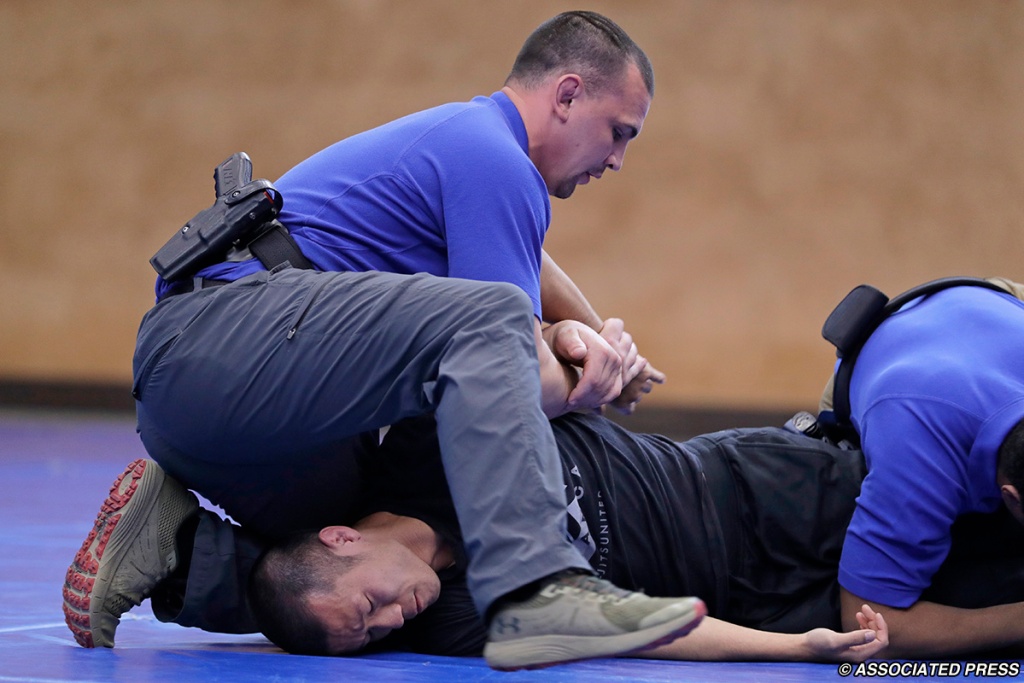
As a law enforcement officer, you know that your job can be dangerous, and that you may encounter combative suspects at any time. That’s why it’s critical to have the right defensive tactics training in your arsenal. While there are many different approaches to defensive tactics training, Brazilian Jiu-Jitsu (BJJ) stands out as one of the most effective and versatile.
BJJ is a martial art that originated in Brazil, and it’s focused on grappling and ground fighting. Unlike many other martial arts, BJJ doesn’t rely on striking or kicking; instead, it emphasizes controlling your opponent’s movements through techniques like joint locks, chokes, and throws. This makes it an ideal defensive tactics training tool for police officers, as it minimizes the physical harm done to combative suspects while still allowing officers to effectively neutralize threats.
One of the key advantages of BJJ for police defensive tactics is that it builds confidence and resilience. Officers who train in BJJ learn how to stay calm and composed in the face of physical danger, and how to use their bodies effectively to control and subdue combative suspects. This can help officers avoid using excessive force and reduce the risk of injury to themselves and others. Additionally, the mental and physical discipline required to master BJJ techniques can help officers develop the resilience and focus needed to perform effectively under stress.
Another advantage of BJJ for police defensive tactics is that it’s highly adaptable to real-world situations. In contrast to many traditional martial arts, BJJ training focuses on real-world scenarios and techniques that can be applied in a wide range of situations. This means that officers who train in BJJ are better equipped to respond to a variety of threats, and can adapt their tactics to the situation at hand.
Finally, BJJ’s emphasis on control and restraint makes it a highly effective tool for minimizing harm to combative suspects. Unlike striking or kicking, which can cause serious injury or even death, BJJ techniques allow officers to subdue suspects without causing unnecessary harm. By controlling an opponent’s movements and neutralizing their ability to resist, officers can safely and effectively subdue combative suspects without resorting to excessive force.
In conclusion, Brazilian Jiu-Jitsu training is an excellent way to provide police officers with effective defensive tactics training that builds confidence and resilience, and minimizes harm to combative suspects. By emphasizing control, adaptability, and real-world scenarios, BJJ can help officers be better prepared to face the physical and mental challenges of law enforcement. If you’re a law enforcement officer looking for a powerful tool to add to your defensive tactics toolkit, consider exploring Brazilian Jiu-Jitsu training.